Fernando Pessoa Imagination and the Self – A Dialogue with Jonardon Ganeri
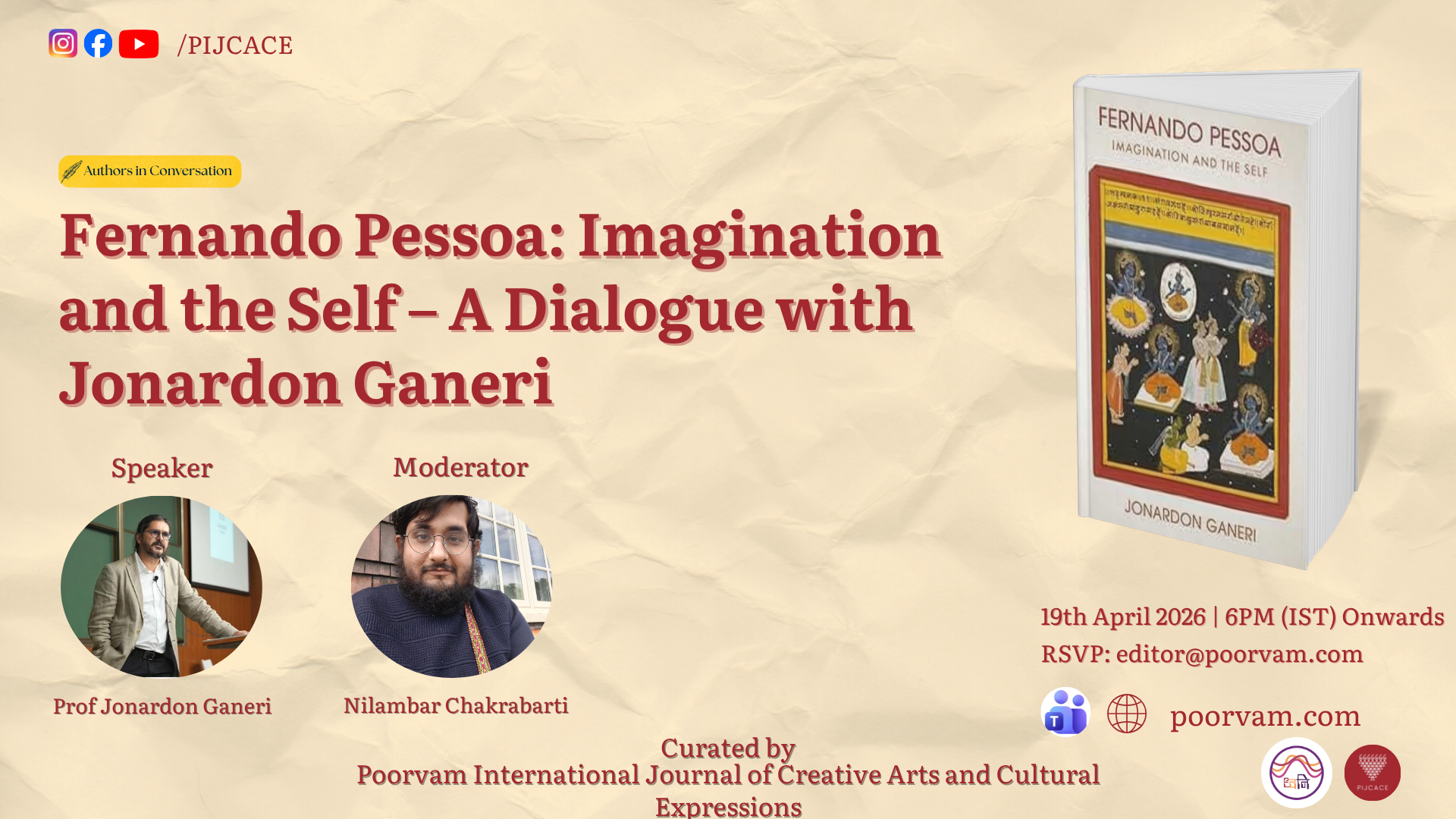
In this lecture and open discussion, Jonardon Ganeri introduces the central argument of his recent book, Fernando Pessoa: Imagination and the Self (Oxford University Press). Taking the Portuguese poet-philosopher Fernando Pessoa as a \\\\\\\"philosophical outsider,\\\\\\\" Ganeri develops Pessoa\\\\\\\'s concept of the heteronym — the idea that the self is not a unitary entity but can be genuinely pluralized through an act of imagination he calls heteronymic virtualization. Against David Chalmers\\\\\\\'s account of virtual reality, which virtualizes environments and bodies but leaves the subject untouched, Ganeri proposes a \\\\\\\"Reality Double Plus\\\\\\\": virtual selves that are as real as actual ones. He distinguishes two forms of self-pluralization: sequential (living as a series of distinct virtual selves) and simultaneous (occupying multiple first-person points of view in parallel). He then traces resonances of these ideas in the Yoga Vāsiṣṭha — in the story of the hundred Rudras and the two Leelas — and, in discussion, in the Jātaka stories and the Rāsa Līlā of Krishna. The conversation ranges across questions of agency, the Sanskrit concept of avatāra, the narrative versus dramatic self, the ethics of recognizing others as plural, and the role of grief and imagination in self-transformation.

Fernando Pessoa: Imagination and the Self
A Dialogue with Jonardon Ganeri
Series: Authors in Conversations · Online Dialogue
Moderator: Nilambar Chakrabarti
Date: 19 April 2026
Duration: approximately 90 minutes
Format: Lecture & Q&A
ABSTRACT
In this lecture and open discussion, Jonardon Ganeri introduces the central argument of his recent book, Fernando Pessoa: Imagination and the Self (Oxford University Press). Taking the Portuguese poet-philosopher Fernando Pessoa as a "philosophical outsider," Ganeri develops Pessoa's concept of the heteronym — the idea that the self is not a unitary entity but can be genuinely pluralized through an act of imagination he calls heteronymic virtualization. Against David Chalmers's account of virtual reality, which virtualizes environments and bodies but leaves the subject untouched, Ganeri proposes a "Reality Double Plus": virtual selves that are as real as actual ones. He distinguishes two forms of self-pluralization: sequential (living as a series of distinct virtual selves) and simultaneous (occupying multiple first-person points of view in parallel). He then traces resonances of these ideas in the Yoga Vasistha — in the story of the hundred Rudras and the two Leelas — and, in discussion, in the Jataka stories and the Rasa Lila of Krishna. The conversation ranges across questions of agency, the Sanskrit concept of avatara, the narrative versus dramatic self, the ethics of recognizing others as plural, and the role of grief and imagination in self-transformation.
About the Speaker
Jonardon Ganeri is Bimal Krishna Matilal Distinguished Professor of Philosophy at the University of Toronto. His work bridges Indian and Western philosophical traditions to develop new ideas about the self, mind, and knowledge. His books include The Self, Naturalism, Consciousness and the First Person, The Concealed Art of the Soul, Virtual Subjects, Fugitive Selves, and Inwardness: An Outsider's Guide. His most recent book, Fernando Pessoa: Imagination and the Self, brings Pessoa into dialogue with Indian philosophical systems. He was elected a Fellow of the British Academy in 2015 and received the Infosys Prize in the Humanities the same year.
The following is an edited transcript of a lecture and open discussion hosted by the Poorvam research community on 19 April 2026. The conversation ranged from the concept of the heteronym and virtual selfhood to comparative resonances in the Yoga Vasistha, the Jataka stories, and the Rasa Lila, as well as questions of agency, ethics, imagination, and the limits of self-unity. Minor edits have been made for clarity and readability.
OPENING REMARKS
JONARDON GANERI
Let me start by saying how this book came into existence. Oxford University Press launched a series called Philosophical Outsiders, and they asked me to contribute something. At that time I was already thinking about the philosophy of self of Fernando Pessoa, and I thought he counts as a philosophical outsider in several different ways.
First, he was not affiliated to any university — he was a completely autonomous philosopher. Second, his thinking is almost entirely detached from any mainstream philosophical tradition. And third, he was an outsider in the rather specific sense that he lived outside of himself. This is the idea of the heteronym, which I want to explain. He lived his entire life trying to be someone other than the person he was.
I had already written one book about Pessoa — an attempt to show that, although he was not a trained philosopher and wrote no scholarly essays, there is nevertheless a system in his work: a philosophy of mind that can be defended using the tools of analytical philosophy. In this new book, I wanted to go further — to look into the literature of classical India to see whether the heteronymic conception helps us understand arguments there, and whether the Indians had already worked with something like it.
THE HETERONYM: A VIRTUAL SELF
JONARDON GANERI
The easiest way to get one's head around Pessoa's idea is to imagine playing a virtual reality game. David Chalmers recently published Reality+, in which he argued that virtual worlds are real — not illusions, not mere appearances, but as real as the actual world. That is why he called his book Reality Plus: reality extended.
But there is something missing from Chalmers's account, and what is missing is exactly what Pessoa provides with the heteronymic conception. In Chalmers's scenario, you have your avatar — a virtual body, a virtual environment — and yet it is still you. The same you who is wearing the headset is the one immersed in the game. But if we can virtualize environments, and if we can virtualize bodies, why shouldn't we also be able to virtualize ourselves? Why shouldn't we be able to inhabit a virtual self, just as we can inhabit a virtual body in a virtual environment?
That is the idea missing from Chalmers's account. I want to call it Reality Double Plus: the view that virtual environments can contain virtual subjects, virtual selves — and that these are just as real as the actual subject. That is the idea of heteronomy: the idea that one can simulate within oneself an alternative, a virtual self.
This matters because it means the self is not unitary. Many philosophers in both India and the West have found the idea of a unitary self extremely problematic. On one hand, we want to say there is some unity to consciousness. On the other hand, the Cartesian picture of an immaterial mental substance is deeply problematic and almost universally rejected today. One response is the Buddhist response: simply to say there are no selves. Pessoa's solution was motivated by exactly the same considerations, but diametrically opposite. His solution was to pluralize the self. He said, in one of his more famous poems, that oneness is a prison, oneness is a trap. In imagination — and he was a poet — we can virtualize ourselves and live as a plurality of different experiencing subjects. His way of escaping the trap of unity was to pluralize rather than eliminate.
"Oneness is a prison, oneness is a trap. Who wants to be trapped in a fixed character, to live their entire life having only one way of experiencing the world?" — Jonardon Ganeri, paraphrasing Pessoa
There are two distinct notions of pluralization at work in Pessoa. The first is sequential: I can invent a virtual subject of experience, live vicariously through that invented other, and then invent another, and another. My life consists in a chain of virtual selves, one following the next.
Pessoa's second notion is far more radical. He seemed extremely committed to the idea that one can virtualize oneself simultaneously — that one can live simultaneously occupying a multiplicity of distinct first-person points of view. He says he can imagine being two people walking down the street and being both of them at the same time. Not as a fusion of the two — points of view don't fuse — but as simultaneously both of them. I call this in the book pluralization by living a life in parallel. This second idea is very hard to make sense of, and that is precisely its virtue: it forces us to think again about what we mean by a first-person point of view, and thereby what we mean by being a subject.
INDIAN RESONANCES
JONARDON GANERI
Where did I find these ideas in classical India? Most of my sources were in the Yoga Vasistha, a great philosophical storybook containing sixty-four deeply philosophical stories embedded in its text.
For the sequential notion of pluralization, there is the story of the hundred Rudras. A sage falls asleep and in his dream sees himself as a bee. The bee falls asleep and sees itself as a deer. The deer falls asleep and sees itself as an elephant. This goes on through a chain of one hundred different virtual identities before returning to where it started. They are all Rudra, and yet they are all different subjects — differently embodied, with different ways of experiencing the world.
For the simultaneous notion, I found what I was looking for in the second story of Leela. Leela's husband, King Viduratha, dies. Leela wants to see him again, so Sarasvati takes her to an imaginary world where Viduratha is living — with a wife whose name is also Leela, physically identical to the first. So Leela, in this projected world, sees herself — the second Leela — standing next to her husband. She is simultaneously occupying two points of view: an external one looking down upon the scene, and a participant one in which she is a character within it. It is the same Leela in both cases. These two stories seemed to me to be illustrations of the two different ways in which one could pluralize oneself by living one's life as a heteronym.
DISCUSSION
NILAMBAR CHAKRABARTI
Is an avatar best understood as an incarnation of a single self — Vishnu remaining Vishnu — or is it a heteronymic transformation where the authentic self genuinely becomes another?
JONARDON GANERI
The term avatar has entered English especially through gaming, where it means the virtual body you have executive control over — and that is how Chalmers uses it. But that is just reincarnation in the literal sense: being incarnated differently, occupying a different body. That does not take us to the notion of a heteronym, because heteronomy isn't simply me finding myself in a different body. It is me living my life, experiencing the world, having thoughts and feelings and emotions — as if another person, with a completely different emotional, cognitive, affective, volitional landscape.
What does the Sanskrit word avatara actually refer to? Chalmers attempts a little exegesis of Hindu scripture but takes avatara to mean the gaming concept of avatar, and I think that is quite wrong. It would imply that when Vishnu comes down reincarnated as Matsya, it is just Vishnu — Vishnu the God, turning up in a half-fish, half-man body. But that is not what the concept means. It is Vishnu recreating himself as Matsya — living the life of a half-fish, half-man, experiencing the world as Matsya, not simply inhabiting Matsya's body. The proper Sanskrit notion of avatara corresponds to heteronymic virtualization; the gaming concept of avatar is mere reincarnation.
MADHUCCHANDA SEN
What do we gain, philosophically, by this pluralization? And is there not an alternative reading — that we were plural from the very beginning, constituted through taking different eye-positions, rather than needing to create heteronyms?
JONARDON GANERI
Pessoa's argument was that every time I virtualize myself, I experience the world in a new way. So it is like the skill of empathy, but far deeper. I am not mind-reading somebody else — this is still a first-person take on the world, but from a cognitive, affective, volitional standing quite different from the one I happened to be born with. It enriches experience and, I would argue, cultivates the skill of empathy directed towards others. It is a way of making oneself a better human being.
As to whether we were plural from the beginning — I don't think this is an alternative. I think that is Pessoa's view. We are all, at least latently, plural subjects. It is just that society conditions us to think of ourselves as unitary selves, and we don't explore this dimension of ourselves. But the claim is that this is the nature of human subjectivity as such: to be inherently plural in potential.
MONIMA CHADHA
I was thinking of the Jataka stories — they end with "and thus was I." The Bodhisatta remembers former lives, including as animals. Is that not a case of sequential heteronomy? And in what sense is it the same subject across such radically different lives?
JONARDON GANERI
The Jataka example sounds absolutely apt — precisely the kind of thing I was hoping to find. The philosophically interesting element is the formula "and thus was I," because the whole question is what the I means in a case like this.
What is required for being a subject is having a first-person point of view — a position from which one views the world and one's experience of it. A mere bundle of psychological events doesn't add up to that. And crucially, that position needn't be coincident with one's actual body. Valberg, in Dream, Death and the Self, makes a lovely point: in a dream, I can be sitting at a table looking at someone. In that dream, I am the one occupying the point of view — the one doing the looking. One can occupy a first-person point of view in a dream, a simulation, a poem — quite different from the one one has in actuality. In Pessoa's case, that point of view is realized in poetry. And since the heteronyms write poetry, they exercise agency. They are not depersonalized — on the contrary, they are hyper-personalized.
MEERA BAINDUR
I want to point out the simultaneity of the self in the Rasa Lila of Krishna — stories where seekers find Krishna simultaneously present with every Gopika, dancing with one, adorning another. That seems a powerful case of parallel pluralization. I also want to ask: is this curation or imagination? And is it a split self?
JONARDON GANERI
The Rasa Lila example is wonderful — I hadn't thought of it but it is a perfect case of the parallel conception of pluralization. And yes, there is certainly a lot of curation involved in Pessoa. He was a very elusive literary figure.
But I would resist the language of the split self, and this is important. That vocabulary belongs to the unified conception of the self: we have a single self and potentially it gets split or fragmented. That is precisely the picture of selfhood that Pessoa is trying to distance himself from. Each of the heteronyms is, for him, a fully rounded, complete self. When there is a plurality of such selves, it is a plurality of whole, non-split selves — not a mereological splitting of a single self, but a genuine case of pluralization. Many selves, each complete within itself.
NILAMBAR CHAKRABARTI
Does Pessoa's heteronymy suggest a multiple centre of consciousness, or a single shifting centre of consciousness?
JONARDON GANERI
Both — and that is a very good way to describe the two co-present conceptions of pluralization. A single but shifting centre of consciousness would be living a life in series. A multiplicity of centres of consciousness would be living a life in parallel. Both are what Pessoa means by pluralization.
RITA RAY
I am a literature scholar and a translator of Pessoa into Bengali, and I completed my doctoral work on heteronymy and impersonalization in Pessoa, T. S. Eliot, and Saint-John Perse. I want to note that Pessoa's theory of heteronymy is grounded in his theory of sensacionismo — a theory of feeling with four stages through which the self begins to split. He was also acutely conscious of the fear of madness throughout his life; his paternal grandmother was confined to an asylum. The voice in heteronomy comes partly from Thomas Carlyle's Sartor Resartus, which Pessoa read obsessively — I have seen his annotated personal copy at the Casa Fernando Pessoa. And when we speak of imagination in Pessoa, it is not mere fantasy: it is an active tool to feel and create reality. As one poem puts it: I simply feel with imagination. You cannot fully understand Pessoa through translations alone.
JONARDON GANERI
Thank you for all of this. On the point about reading Pessoa in the original: Pessoa himself wrote a great deal in English, which is itself significant. His dream was to become an English-language poet, and his published output in his lifetime was mostly his English poems — it was only Mensagem, a slim volume in Portuguese, that appeared in Portuguese, and even that was partly propaganda. His last words, reportedly, were in English: I know not what tomorrow will bring.
KEVIN JOHN KOHN
How does Pessoa's theory relate to the narrative self — the idea associated with Schechtman and others that the self is essentially an autobiographical construction? Pessoa crafted elaborate biographical identities for each of his heteronyms. Is that not a narrative project?
JONARDON GANERI
Reviewing Pessoa's texts, I cannot think of him engaging much with the narrative conception of self. His conception is not so much narrative as dramatic. What interests him is what happens to an actor as they move into a part — they become the character they are playing. That movement into part, what you might call the dramatization of the self, is the literary phenomenon he appeals to when trying to understand selfhood.
The Book of Disquiet has no narrative structure — its protagonist, Bernardo Soares, shows no development through the book. The first Bernardo Soares is the same as the last. And Pessoa's poetry is written in the first person with no narrative arc. I would say he is a dramatist, not a storyteller. The invented biographies of the heteronyms — Caeiro dying young, Campos as the great engineer-explorer — help us as readers understand what kinds of subjects of experience they are. But that is different from saying they construct a self through narrative.
ANUGYA
I was thinking of Keats's idea of negative capability — his celebration of Shakespeare for being able to inhabit the voice of Iago one moment and Imogen another. Given that you said Pessoa was essentially a dramatist, is there something there? And separately: the story of Leela struck me — she has lost her husband, and it is out of grief that she seeks this experience. Is there something about mourning that can push us to inhabit a virtual or alternative self? And finally: if plurality aids ethics, is recognizing others as multiple selves — not just oneself — what is truly required for ethical life?
JONARDON GANERI
On Keats — the first chapter of the book does exactly this: I discuss Keats, then Shakespeare, and then Pessoa to draw out what they share and where they diverge. All three have a project of self-estrangement. But Pessoa is doing something distinctively new and modernist — deeply familiar with Keats and the tradition of Shakespeare as the universal poet, and yet exceeding both.
On grief and the Leela story — that is something I genuinely hadn't thought of before, and now that you say it, it seems very rich. I'll have to return to it.
On the third point — whether ethics requires recognizing others as having plural selves, not just claiming plurality for oneself — I think that is absolutely right, and I am grateful for the formulation. Thinking of others not as fixed objects but as inherently fluid and multifaceted surely encourages a whole spectrum of ethical qualities: compassion, understanding, forgiveness. There is something deeply problematic, ethically, about regarding others as subjectively rigid — and a great ethical insight in refusing to do so. That is a point I simply hadn't articulated before.
CLOSING
AMRITANATH BHATTACHARYA
We are deeply grateful to Professor Ganeri for this conversation, and to all participants for the quality of attention they brought to these ideas. Upcoming Poorvam events include a dialogue on Matilal's way of doing Indian philosophy on 9 May; Professor Dan Zahavi on Being We: Phenomenological Contributions to Social Ontology on 17 May; and Arjun Bharadwaj on the dramatic element of the Kumarasambhava on 13 June. All events are free, online, and begin at 6 PM IST. Details and registration are available on our website.
JONARDON GANERI
Thank you all for the fantastic questions and insights. It has given me a great deal to take home.