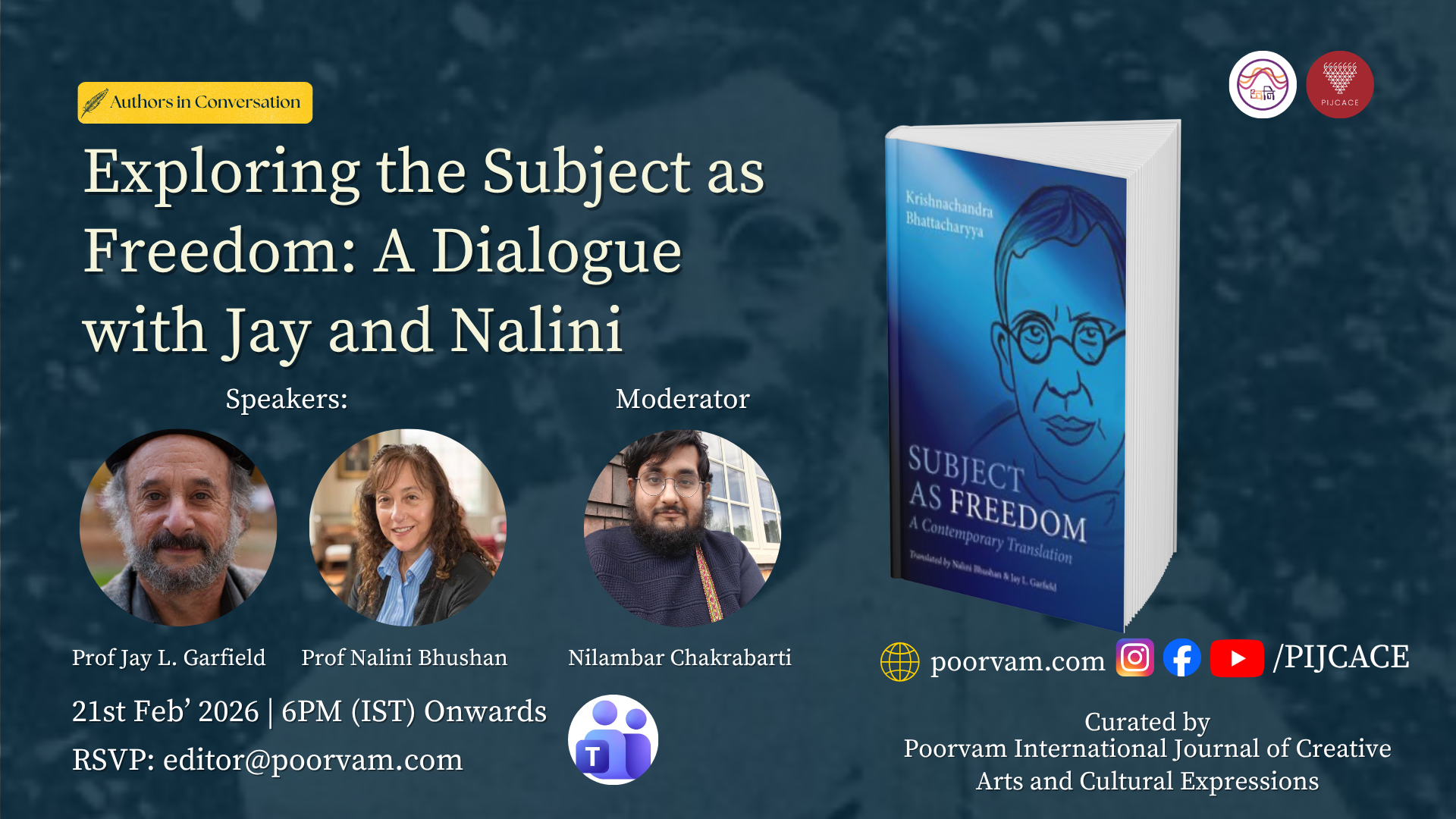
Transcribed from the recorded session of 21 February 2026. Speaker identifications are editorial. Jay Garfield\\\\\\\'s transcript artefacts (automated voice-assistant interjections) have been silently removed. The speakers\\\\\\\' words are otherwise their own, with minor punctuation for readability.

Exploring the Subject as Freedom
A Dialogue with Nalini Bhushan and Jay Garfield
Date 21 February 2026 Duration 2 h 13 m Format Recorded seminar, transcribed Subject K. C. Bhattacharya, Subject as Freedom
Participants
Nalini Bhushan (Speaker)
Jay Garfield (Speaker)
Nilambar Chakrabarti (moderator)
Jayita Sengupta (Audience questioner)
Raghurama Raju (Audience questioner)
Mousumi Guha Banerjee (Audience questioner)
Upal Chakraborty (Audience questioner)
Govert Schuller (Audience questioner)
Annapurna Tripathi (Audience questioner)
I. ORIGIN OF THE PROJECT
Nalini Bhushan
Jay and I had been working on the colonial Indian philosophy in English period for quite a while. We had put out an anthology first, featuring all the major philosophers of that period. Then we wrote our monograph in 2017 — Minds Without Fear — where we actually wrote our own ideas about that period.
Nalini Bhushan
Through it all, as we were getting more and more illuminated in terms of what various philosophers were saying, one person's ideas kept eluding us and challenging us and frustrating us. That was K. C. Bhattacharya's book, Subject as Freedom. We would write about some of his more familiar texts — the Concept of Philosophy, the Svaraj in Ideas, the Concept of Rasa — but Subject as Freedom as a text was continually frustrating us.
Nalini Bhushan
So we made a decision: rather than write about his work, what if we took his words literally and tried to go almost line by line and produce what we call a translation — a homolinguistic translation, from English to English — which would be 21st century but would stay very close to his own text.
Nalini Bhushan
We wanted to keep his voice and his words alive, rather than getting lost in our own. The solution was a side-by-side format: K. C. Bhattacharya's sections on the left-hand side, our English on the right. That way it would show people exactly how we are doing the translation. If people want to challenge us, they can look on the left-hand side and say: no, I disagree. That conversation was something we wanted to welcome.
Nalini Bhushan
For me, the deeper reason is something about respect. To respect his voice, his text, keep it alive, you have to have it right there alongside ours — because that shows that his voice is being preserved. If it's being lost, you can criticise us for it. Ethically, this felt like the right way to present it.
II. BRINGING A MASTERPIECE BACK INTO CIRCULATION
Jay Garfield
As we read K. C. Bhattacharya's work — even when we were struggling to understand it — we gained an enormous respect for his thought. But we were also conscious of a very troubling conversation we kept having. Who were the major voices in this period? K. C. Bhattacharya, of course. What was his most important work? Subject as Freedom — a great masterpiece. Have you read it? And then there would be a long pause: No, it's too difficult.
Jay Garfield
We had this sense of a masterpiece that nobody was reading. So we thought: one of the things we could try to do is to make it more accessible to contemporary readers — to invite people to read it today. We don't want to erase K. C. Bhattacharya's own voice — it's there on the left-hand side. But we wanted to provide a version that would make reading possible.
Jay Garfield
Translation means to bring something across. We're trying to bring K. C. Bhattacharya's voice from his period across to readers from this period. We thought it was important not to be writing about the text, not to be offering an interpretation — but to re-present it in a way that would be accessible. If we've done that, we're happy. If not, people can look at what we've done and say, you got it wrong. But at least we'll get the text back into circulation. That was our very great hope.
III. CHALLENGES OF TRANSLATION
Nilambar
What were the most significant challenges you faced while translating K. C. Bhattacharya's work into contemporary idioms?
Jay Garfield
The greatest challenges were these. First: K. C. Bhattacharya coins a lot of words, or uses words in ways that are very unfamiliar. He is using his own language that really doesn't correspond to what others are using. You have to ask: what does this word mean in his mouth? How would we say this in 21st-century English?
Jay Garfield
A second problem: it became obvious that K. C. Bhattacharya is often thinking in Sanskrit and writing in English. So sometimes the question we had to ask was — with the way he's using this word, what's the Sanskrit he's hearing behind it? And what would be a different way to translate that into English?
Jay Garfield
A third challenge: while K. C. Bhattacharya is referring throughout to a great deal of other philosophy — to Kant, to Husserl, to Śaṅkara, to Sāṃkhya — he never explicitly refers to anything. He cites no sources, mentions no other texts, no other figures. Part of what you're trying to do when understanding him is to figure out with whom he's in conversation, and he's not telling you. That is often an enormous difficulty.
Nalini Bhushan
One challenge we faced was a temptation to add extensive footnotes — this sounds like Kant from such-and-such, this has a Hegelian structure, and so on, linking it also to Advaita and Nyāya. But once we do that, we are popping out of translation mode and going into a commentarial mode. So the challenge was to keep cutting back. If you look at the book, the footnotes are very few. We decided: only footnotes where we are explaining something he himself is talking about, not connecting it to other traditions.
Nalini Bhushan
And then there is a loss. K. C. Bhattacharya writes with such poetry — he talks about the tingling of subjectivity, about the speakable and the meanable. Our students who went through the translation with us were criticising us: you're losing all the poetry. And so the challenge was whether to hold that, or to acknowledge we are taking that loss for the sake of a kind of philosophical 21st-century clarity. We give him the poetry on the left side. We take the more prosaic way of presentation.
IV. RESONANCES WITH CONTEMPORARY PHILOSOPHY
Nilambar
Did you find resonances between K. C. Bhattacharya's conception of subjectivity and contemporary philosophers like Shaun Gallagher or Dan Zahavi?
Jay Garfield
There's enormous resonance. K. C. Bhattacharya is operating in a framework that is redolent both of Kant and Husserl. To that extent, because he's picking up those threads, some of the people you mentioned — who are also very influenced by both Kant and Husserl — you begin to see deep similarities, but not identities. K. C. Bhattacharya is a very creative philosopher on his own. He's not simply repeating Husserl, he's not simply repeating Kant. There's also a great deal of Advaita Vedānta in his work, and a great deal of Nyāya.
Jay Garfield
The concern with isolating the nature of subjectivity itself and inquiring about what subjectivity looks like when it's free of the object — that's very much a Husserlian project. But he's also developing a kind of critique of givenness that aligns him more with Sellars. He's also worrying about the role of collective community practice in constituting linguistic meaning and subjectivity — which reminds you of Wittgenstein. So there are so many people to whom you could draw connections, but you don't want to draw to any one of them and say, he's really just this — because what he really is, is K. C. Bhattacharya.
Nalini Bhushan
I've been recently wrestling with a paper on bodily subjectivity and looking back at K. C. B.'s chapters 3 and 4. What's so striking is the connection with Husserl's Ideas — the examples of perception, the relationship between self and object. K. C. B. gives examples of the tree in the field, the missing book. Husserl talks about a piece of paper in front of you. And Husserl uses language that I noticed is actually coming into K. C. B., but in his own way — with regard to what he calls conscious non-perception. He's drawing inspiration from many philosophers and then doing one better, I think.
V. ON 'CREATIVE PHILOSOPHER' — A METHODOLOGICAL DISPUTE
Raghurama Raju
I congratulate both Nalini and Jay for undertaking this courageous work. But I would avoid the expression creative philosopher when applied to K. C. Bhattacharya. This is also one of the anxieties of Gopinath Bhattacharya — and I think it is problematic. The reason is that we are unwittingly over-privileging creativity and novelty.
Raghurama Raju
There is a different genre altogether, equally important if not more so, and that is compiling. It comes with responsibility. K. C. Bhattacharya doesn't claim himself to be a creative writer — despite the claims by Gopinath. Because I think what K. C. B. is doing is something very important: an ethics of responsibility, becoming a compiler of the classical writers against the background of colonialism, so that continuity is accrued rather than difference through creativity.
Raghurama Raju
I find here something very interesting: Jay and Nalini are doing to K. C. Bhattacharya what K. C. Bhattacharya did to classical Indian philosophical systems. That is a contemporary statement of classical philosophy in a modern idiom. It is courageous — I know you will get a lot of pushback, but I am with you.
Nalini Bhushan
Raghu, you've got me thinking about the phrase creative philosopher in a way I hadn't before. When you do that — emphasise creativity and novelty — you're over-privileging one genre over another equally important one: the act of compiling a tradition, responsibly presenting it. But perhaps there is a way to think about someone who is creative in the sense of having the insight to put different traditions together — which might not be merely novelty, but another instance of compiling a tradition, but in one's own way.
Nalini Bhushan
The creative act of pulling out what is the deepest truth of a classical tradition and presenting it, such that we understand most fully what is so deep and interesting about it — I think it is this latter form of creativity that K. C. Bhattacharya is up to.
VI. THE METHODOLOGY OF TRANSLATION VS. COMMENTARY
Jayita Sengupta
Amritanath and I have been thinking of working on Gopīnāth Kavirāj. He belongs to the same type. Amritanath had actually translated a section from Dīkṣā, and we were going through it — and as you just mentioned, if you just put in all the footnotes, the footnotes grow longer. So how did you address this issue? If you wanted to omit the footnotes, the intertextualities embedded in the text — how do you clarify that when you translate?
Jay Garfield
It's really hard. There's no hard and fast rule. But one way to think about it is to ask: are we writing about K. C. B.'s text, or are we presenting K. C. B.'s text? We kept telling ourselves: we're presenting his text. We're not writing about it. We're presenting it so that people can start writing about it again. If we were writing about it, we would be saying: here are Bhushan and Garfield's ideas about what's important — and there we would have a lot of ourselves there, with a lot of notes. But in this book we were doing something very different.
Jay Garfield
Translation is in one sense a very depressing activity, because nobody has ever looked at their own translation and said: I got it just right. You always have to say: I've done the least damage that I could. You have to inhabit that space that is tingling with self-doubt.
Nalini Bhushan
We wrestle with methodology a lot, and I think it kind of remains unsettled. That very unsettledness that we feel is almost a philosophical, phenomenological feeling — you articulate your methodology as much as you can, and then you just inhabit that space as you do your work.
VII. SVARAJ IN IDEAS AND SUBJECT AS FREEDOM — TWO NOTIONS OF FREEDOM
Nilambar
In Svaraj in Ideas, K. C. B. is talking about a nature of freedom. In this book, he's also talking about freedom. Are they different? Does Subject as Freedom presuppose the spirit of the svaraj ideas?
Nalini Bhushan
In Svaraj in Ideas, I think he's talking about a subjectivity located in a political milieu — asking what does one's subjectivity look like under colonialism. It's a wonderful argument in support of this idea of figuring out what is an authentic subjectivity, as opposed to a shadow, an inauthentic one. There, the notion of subjectivity is different because of its location in the political context.
Nalini Bhushan
When he writes Subject as Freedom, it's almost like the political, social, economic context disappears. He is talking pure epistemology, pure metaphysics, the nature of subjectivity in itself. There's very little intrusion in that text of the political, the social, the economic, or gender. So is that a different kind of freedom? A freedom experienced differently in the political milieu? That is an interesting question.
Jay Garfield
I see Svaraj in Ideas as concerned with a subjectivity that would be free from the shadow domination — the ghostly possession, as he puts it, of a colonial subjectivity. In Subject as Freedom, he's asking a parallel but much deeper question: what does subjectivity look like when it's completely free? I see Svaraj in Ideas as a kind of special case of the big question being asked in Subject as Freedom — not how could you be free from this or that, but how could subjectivity itself be freedom? They're connected, but you could almost see Svaraj in Ideas as the special case and Subject as Freedom as the big picture.
VIII. THE NATURE OF FREEDOM — OPEN DISCUSSION
Mousumi Guha Banerjee
You are showing freedom as awareness, or freedom as a sense of subjectivity. I'm wondering whether that kind of freedom is possible — because freedom might mean simply to do what I want, go where I want to go, spend my life as I want. Absolute freedom is something we in our situations probably cannot conceive. So how can we really have freedom of that kind? Are you talking about an awareness that the subject comes to have when it comes to realising freedom? Is it that kind of education you have in mind?
Jay Garfield
One of my most pressing questions when I began reading this book was: what is the difference between talking about the subject as free, and talking about the subject as freedom? K. C. Bhattacharya begins with a really simple-sounding question: what is the relationship between the subject and its objects? Even at the level of bodily subjectivity, we experience our subjectivity as kind of bound by the objects for which we're subjects.
Jay Garfield
As he ascends through psychic subjectivity and then to spiritual subjectivity, he's asking: can you have subjectivity without any object at all? Can subjectivity itself be free of an object? When we frame it that way — can the subject be free? — we recognise that we're asking the wrong question. We've already constructed a duality of subject and object, and a thought of the subject as the thing that has the object.
Jay Garfield
The insight he's drawing on — which comes from classical Advaita more than anywhere else — is that the moment we distinguish subject from object, we've fallen into a trap that makes it impossible to understand what the subject is. If instead we ask about non-dual subjectivity, then subjectivity itself is a freedom from objectification. It's not a positive freedom to do things, or a negative freedom not to be affected by things, but the absence of the implication of subjectivity itself with objectivity. That takes K. C. Bhattacharya beyond Kant in important ways.
Nalini Bhushan
I hear the scepticism in your question — what you were talking about was a kind of agentic freedom, freedom as agents: I am a person who wants to do things that align with my beliefs and desires. And what we recognise in Subject as Freedom is that K. C. B. is not interested in that — because you're still there thinking about the agent as a self, as an object, as a thing, as an entity that you want to be free.
Nalini Bhushan
What he's going for is a kind of phenomenological freedom. Throughout the text — through bodily subjectivity, psychic subjectivity, spiritual subjectivity — he keeps talking about the sense that there is something more than what we feel, what we see. At the final level of spiritual subjectivity, he's proposing a future freedom: something we don't yet have, but that we have a faith or a confidence in — our internal felt self keeps demanding: there is more than this. Your question, couldn't that be illusory? Perhaps it might. But when I reread Subject as Freedom through the suffering of translating it, my scepticism about the illusoriness of that freedom is assuaged a little bit.
Jay Garfield
Let me add: this is part of the reason that we saw Advaita and its spiritual significance as so important to understanding Subject as Freedom. He really emphasises the nature of philosophy as a sādhana. Exploring our subjectivity is not a disinterested epistemological investigation, but an understanding of a demand for self-transformation — not a transformation into greater agential freedom to do more stuff, but a transformation that allows us to de-thematize ourselves as objects among objects, to become free from that sense of ourselves as a thing among things.
IX. SUPERIMPOSITION AND THE COSMIC ILLUSION
Govert Schuller
I'm wondering whether the freedom K. C. B. is talking about is a kind of transcendental freedom — not agential, not agency. Connecting with both Krishnamurti and Vedānta, and the subject matter of how much duality is there between subject and object — whether, in the ultimate ontological analysis, there is just a monism. I'm working with the whole idea of superimposition — I'm getting the idea that Krishnamurti blows up the duality in his own experiences, breaks through the superimposition of duality upon monism. Heidegger also blows up the Cartesian duality in his phenomenological concept of being-in-the-world. Am I on the right track in suspecting K. C. B. of using these concepts of superimposition and freedom from it?
Jay Garfield
For one, I think you are on the right track. I always get excited when reading K. C. B. because I see him making moves in Subject as Freedom that were going to be made much later by Wittgenstein in the Philosophical Investigations, by Sellars in Empiricism and the Philosophy of Mind, by Heidegger in Sein und Zeit. While he's operating within a framework deeply informed by Kant, Husserl, and the Advaita tradition, I think he's moving beyond that into a much more interesting notion of an embodied, embedded being in the world. The idea that it's not just a subject that's free — it's that we are free from positing subject and objective. You can see that very much in Heidegger's notion of being embedded in a world.
Nalini Bhushan
As we were working through Subject as Freedom, I was so struck by the centrality of superimposition and adhyāsa, and the way in which illusion keeps coming into the text. It starts right at the beginning with bodily subjectivity and perceptual illusions — very ordinary ones that can be corrected. The deep insight of Subject as Freedom, as we move into spiritual subjectivity, is that what we don't realise is that there is a bigger, greater illusion than all the familiar perceptual ones — ropes and snakes and so forth. This is the cosmic illusion. Not just that we superimpose a certain error upon the world — as when we mistake a rope for a snake. The deeper illusion is that we mistake something very close and intimate to us, namely something about our own very nature. That's where the illusion is — that we think that we are selves of a certain kind. That is the deepest superimposition that K. C. B. wants us to be free from.
X. SUBJECTIVITY, GENDER, AND FREEDOM
Annapurna Tripathi
My question is: is freedom defined as an inner self-realisation, beyond social conditioning? If a woman in our society is always conditioned from childhood — about her identity, choices, and thinking, shaped by gender roles and social expectations — if her mind itself is influenced by society, then is her inner freedom truly independent, or still indirectly controlled?
Nalini Bhushan
You're raising the question of whether there are different kinds of subjectivity related to gender, class, race and so forth. The closest K. C. B. comes to that is in Svaraj in Ideas — that's where you get a sense of a subjectivity that is not free, and the question of authenticity, of making sure your actions and thoughts and methodology are your own.
Nalini Bhushan
The other part of your question is whether it is possible for anybody, regardless of social role, to kind of detach — to try out this phenomenological practice of being free, which has nothing to do with one's role. That is a huge challenge. I don't think K. C. B. is directly addressing it, but I think he's giving you the structure for what that might look like if you are able to successfully detach. His conception of total freedom is a future freedom — something to which we aspire. Maybe the right way to think about it is not am I able to achieve it, but: if I set it up as an aspiration, what does it do to my insight? As an aspiration — almost like a regulatory ideal — it is very powerful.
Jay Garfield<