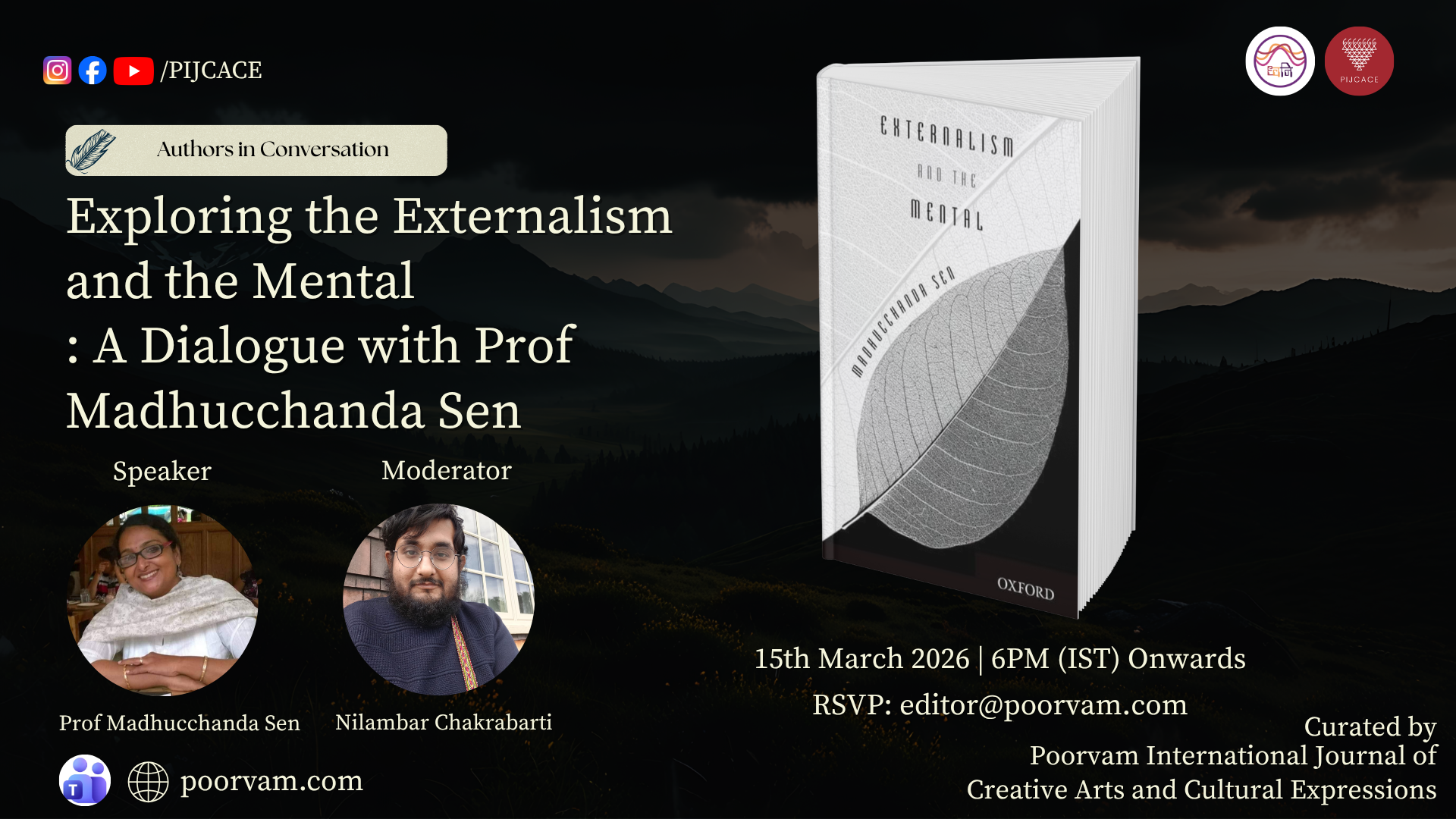
Exploring Externalism and the Mental
A Dialogue with Prof. Madhucchanda Sen
This transcript was recorded on 15 March 2026 via Zoom; the session ran for 1 hour 22 minutes and 37 seconds. The original transcript was auto-generated by the Zoom platform and has been editorially cleaned for publication in Poorvam International Journal of Creative Arts and Cultural Expressions. The following categories of noise have been silently removed: single-word or single-syllable automated utterances (e.g. \\\"The.\\\", \\\"Okay.\\\", \\\"Play.\\\", \\\"Mhm.\\\"), voice-assistant artefacts including Cortana commands and standalone speaker-name calls, filler-only turns (\\\"Uh...\\\", \\\"Um...\\\"), and timestamp-only entries. Fragmented consecutive turns by the same speaker have been merged into single paragraphs. Obvious transcription errors have been silently corrected, Sanskrit and technical terms have been restored to their standard romanised forms, and minimal punctuation has been added for readability. Speakers\\\' words are otherwise their own; no paraphrasing or substantive editorial addition has been made. One participant — Maitreyee Datta — appears in the raw transcript exclusively through voice-assistant artefacts and has therefore been assigned no substantive speech turns; it is possible that their contributions were lost entirely to transcription noise.

SESSION DETAILS
Date: 15 March 2026
Duration: 1 hour 22 minutes 37 seconds
Format: Online seminar (Zoom); Authors in Conversation series
Subject: Externalism and internalism in philosophy of mind; content, demonstrative thought, and the inner–outer distinction
Publication Venue: Poorvam International Journal of Creative Arts and Cultural Expressions
SPEAKER KEY
Prof. Madhucchanda Sen — Presenter — philosopher of mind; author of the book under discussion
Nilambar Chakrabarti — Moderator / Respondent
Amritanath Bhattacharya — Session host / Convenor (Poorvam)
Prof. Amita Chatterjee — Respondent / Discussant
Prof. Rakesh Chandra — Audience questioner
Shivangi Shanker — Audience questioner (PhD researcher, externalism and speech acts)
Manoj Panda — Audience questioner
Abhishek Chatterjee — Audience questioner
Aurchisman — Audience questioner [surname not captured in recording]
Maitreyee Datta — Voice-assistant artefacts only; no substantive speech [FLAG: possible participant whose contributions were lost to transcription noise]
Anirban Bhattacharya — Single back-channel response [FLAG: no substantive turns]
1. Point of Departure: Methodological Solipsism and the Cartesian Inheritance
Prof. Madhucchanda Sen [Presenter]
The essay I have in mind is by Fodor; it is called methodological solipsism, considered a research strategy in cognitive psychology. I was told that this was the way to go — and that was in the nineties, though the paper itself was written in 1979. I thought it would be interesting to quote from it directly. Fodor says that methodological solipsism in psychology is the view that psychological states should be constructed without reference to anything beyond the boundary of the individual who has those mental states. The claim is that in order to individuate mental states as the mental states they are, we need to confine ourselves within the boundary of the person's mind — and, if you will allow me, the person's brain. This view had also strongly influenced cognitive science and endorsed another position that was extremely popular in both philosophy of mind and philosophy of cognitive science: representationalism. Even in January this year, when my son asked me what my New Year's resolution was, I told him that I wanted to understand representationalism — and I wanted to understand why it is so bad, yet why it is so effective. When one claims that everything in the mind must be identified by referring only to what is internal, one is expressing a kind of Cartesian belief: that the mind is self-contained with respect to everything else — in my case, with respect to the world. If we believe in this Cartesian insight and also in the Cartesian cogito, then we are in a perpetual state of uncertainty, because there seems to be a connexion between subjectivity and veracity, and between objectivity and scepticism. In plain terms, the Cartesian insight was that we could be sure of ourselves, but about the rest of the world we can never be sure. This took me back to one of my early interests in academic life — the problem of perception and the theories we were taught as students.
2. Frege, Russell, and the Internalist Reading of the Descriptivist Tradition
Prof. Madhucchanda Sen [Presenter]
When I went to London for my graduate studies, I enrolled myself in a course hosted at King's College but offered by philosophers teaching across all the colleges of London University — Tim Crane, Gabriel Segal, and David Papineau. All of them were giving a seminar on content. There I was told that the Cartesian insight had given rise to the notion of narrow content of mental states and their role vis-à-vis mental states. To my utter shock, I found out that the two persons I had held as intellectual gurus were taken to be the fathers of the notion of narrow content — and they were pretty central to the debate. Segal, Crane, and Papineau all endorsed the view that the descriptivist tradition in philosophy — identified with the works of Gottlob Frege and Bertrand Russell — was endorsing a narrow-content view of mental states. The idea they took to be central was that both Frege and Russell treated empty terms in a particular way, and they thought that the contents of thoughts which, in order to express, we use empty terms — terms like unicorn or Sherlock Holmes — are such that those thoughts must be understood in terms of narrow content, where narrow content is identified strictly within the personal boundary, or rather the brain boundary. They concluded, further, that not only empty terms but all other terms need to be seen in that way. So it was believed that the descriptivist tradition in semantics was wedded to the Cartesian, representationalist tradition in philosophy of mind. Now, I have used the word representationalism — let me say just one small thing about it. I take it to be a certain picture of mind where — and here I quote my other real hero, Davidson — the mind is seen as a theatre in which the conscious self is watching a passing show. And this show consists not of actual objects like this cup or my computer screen, but rather of their purported representatives: sense data, appearances, or the given of experience. It is also believed that if we see our mental states in this way, all thoughts relate to the world in an essentially indirect way — always by means of certain inner specifications, common both to thoughts which are indeed about actual objects and to thoughts which are about fictitious entities. This makes our relation with the world inessential, and also completely fortuitous. This is the idea of the narrow content of our mental states.
3. The Mind as Eternal Exile: Motivations for a New Project
Prof. Madhucchanda Sen [Presenter]
The importance of narrow content in cognitive science and cognitive psychology is extreme. Fodor, writing in 1979, argued that we have to take the narrow stance in order to build cognitive psychology at all: mental states need to be identified in terms of narrow content in order to have the kind of causal explanatory power they require. You cannot do the work you want to do with mental states in cognitive science if you identify them in terms of things that really fall outside the mind. When we mention an object in describing a thought — here I am quoting from McDowell — we are giving only an extrinsic characterisation of the thought, since the mention of the object takes us outside the mind. But there must, according to the narrow content theorists, be a kind of intrinsic characterisation of mental states. And so we end up with the Cartesian insight that mental states are to be identified in terms of their narrow, internal, individualistic content. This leaves us with a very unsettling predicament. It makes the mind an eternal exile from the world. And more significantly, it makes the mind an eternal exile from all other minds as well. I had a great discomfort with this idea. During my MPhil days at Jadavpur I was taught by Chanda Gupta, who made me understand that these classical binaries — intrinsic and extrinsic, subjective and objective, scheme and content, mind and world, self and other, inner and outer — need to be dismantled. She had her own reasons for doing so as an internal realist. For me, after very close reading carried out for almost ten years, I felt that I really did not understand what internal is, and sometimes I did not even understand what external is. And one may think that, if you are writing and researching on the externalism–internalism debate and you are having questions regarding the very dichotomy between the inner and the outer, then your entire project is working against you. Well — yes and no. It does make me sceptical about the validity of the debate in academic orthodoxy; and yet no, because the way a few externalists see their own position really made me understand what could be my position in all this. My genuine question was: is there really a distinction between the inner and the outer? And why do we think we understand it? It seems that both the orthodox internalist and the orthodox externalist assume both that the distinction exists and that they understand it. I, however, think neither.
4. Reconstructing the Mind–World Relation: McDowell, Sellars, and Davidson
Prof. Madhucchanda Sen [Presenter]
In order to understand the mind and its relation to the world — and in order to get out of the dangerous predicament of having a mind in eternal exile — we actually have to redefine and look anew at the mind–world relationship. In the book I have taken help from the insights of a few phenomenologists who are trying to say that the relation between the mind and the world is such that the relation constitutes the relata. The relata being the mind and the world, the relation is of a kind that constitutes both. In order to understand the world differently, I took help from the neo-Kantians — and here I have especially Wilfrid Sellars and John McDowell in mind — who argue against the empiricist tradition's claim that in experience the world is given to us in its true guise as a bare given. Both McDowell and Sellars countered this, very much to my liking, because as an MPhil student at Jadavpur I wrote a thesis on Davidson, who denies the scheme–content dualism and rejects foundationalism grounded in the idea of the bare given. The very simple idea I would like to endorse is that the world we can talk about, think about, and theorise about is the world we can talk about, think about, and theorise about — that is the only world we have. To think that there can be a pristine given untouched by the human mind is a myth. I also seriously want to question the conception of mind that generates the externalist–internalist debate. I start off by following the Wittgensteinian dictum that if you think that in order to know what I have in mind you need to tap into a secret representation, then you would never know what I have in mind and there is no hope of understanding me or my language. He says that if you really think a mind is a secret of incommunicable thoughts, then if God looked into our minds he would not be able to see there whom we were thinking of. And then, if you ask me who I am speaking of, the best way of finding out is to follow my eyes and see whom I am looking at.
5. Demonstrative Thought, Constitutive Relations, and the Object's Entry into Content
Prof. Madhucchanda Sen [Presenter]
With this Wittgensteinian insight, and with the discomfort I had about Frege and Russell as philosophical progenitors of narrow content, I looked closely at their actual texts — Frege and Russell and especially Frege's handling of sense. What I found is that in these systems there is a principle which became a guiding one for me. Very simply stated: we have at least a few thoughts such that if the object that thought is supposed to be about does not exist, we can never have that thought. And if there is another object in the place of the object I am thinking of — even one that is descriptively exactly the same — I would have a different thought. Same object, same thought; different object, different thought. Now, if we can own even one mental state of that kind, then why would we assume that the default condition of thought is thoughts about empty terms, and that the default condition of mental content is narrow content? All my interests seemed to converge here. It is a project of trying to find at least one case where we can say that, in the absence of an object, there is no thought — in the sense that the world has a genuinely constitutive relation with the mind. My mind cannot entertain certain thoughts unless the world comes in and constitutes the thought I have. I made use of Evans's and McDowell's analysis of perceptual demonstrative thoughts, where I am really talking about the semantics of demonstrative terms. When I say this is hot and I am touching my cup, using a genuine demonstrative, then in the absence of this cup the demonstrative simply would not work. And in the presence of a qualitatively indistinguishable cup, the demonstrative would not work in the same way — it would be a different demonstrative. The key point about this cup is not that it satisfies some abstract description — it is that it causes me to have this demonstrative thought because it is the object it is. The causal efficacious property that this cup possesses, such that it becomes the object of my demonstrative thought, is not some abstract property any other cup could satisfy. The property is simply being the object it is — and that is nothing but the object itself. By this route, the constitutive relation between the world and thought really catches one between the purely causal and the purely descriptive. We need to see the inner–outer distinction with a pinch of salt, and we need to accept that what can be external can also be intrinsic to the mind — and hence the inner–outer distinction is not so hard and fast as we took it to be.
6. On the Difficulty of Dissolving the Binary: Self-Awareness and the Constituted Subject
Nilambar Chakrabarti [Moderator]
Given the analytic background you have had, did you find it difficult to go beyond the inner–outer binary while sketching your arguments for the book?
Prof. Madhucchanda Sen [Presenter]
Of course I did. There was a great deal of reservation about dissolving this binary. One may feel that we do sort of find something inside that is not quite outside — we feel that there is an inner world, whereas there is an outer world. But I think — and this is becoming clearer to me more and more — that the world I take to be inner: my thoughts, my feelings, my emotions, my moods, my identity, my persona, my self-awareness, my sense of myself, my sense of my own mental states, my sense of myself in the world — all these things are not things that have been generated purely within me. My recent work is mostly on self-awareness, and in many places I have tried to argue that the idea we usually associate with self-awareness — as a kind of inner recording of a mere subjectivity, a recording of sheer innerness — is something I do not accept. I think our self-awareness is largely constituted by many things which are not within that strict inner boundary and cannot be understood in terms of a mere subjective presence. And if that which is supposed to be absolutely sacrosanct, subjective, and narrow — if that itself is penetrated by culture, language, others, politics, the world, and — in a very significant sense — my body, my body in the world, and my bodily identity, then it is time that we at least diffuse the boundary between the inner and the outer.
7. The Question of Comparative Philosophy: A "Cultural Nomad"
Nilambar Chakrabarti [Moderator]
You have referred to Indian philosophical frameworks in your talk. Did you have a comparative philosophical framework in mind while writing the book?
Prof. Madhucchanda Sen [Presenter]
Not really. And I keep saying this wherever I go — the kind of upbringing that we had in the Indian academic scenario, at least in West Bengal, because that is what I know: the curriculum that was followed in our time. We were being taught everything. We would have a class on Kant, reading the Prolegomena, and then the next class would be on Nyāyakusumāñjali, and the next on Cartesian meditations, and the next on meta-logic. So I do not really see myself as a comparative philosopher; I see myself as a product of colonial education — and of an education system built by Indian academics who were desperately trying to provide the next generation with both classical Indian philosophy, out of their own nationalistic fervour and deep faith in how philosophy was done in classical India, and also their belief that students needed to know modern logic, needed to be exposed to the phenomenological tradition, and needed to know analytic philosophy. So I was drawing on resources from wherever I got them. For example, I spoke in the book about Husserl, but I do not claim to be a Husserl scholar. I took certain ideas which may possibly cohere with my other ideas, even if Husserl himself would not have accepted them. You could say that I am a kind of — I don't know — a cultural nomad. This is what I feel. I do not see myself as a Western philosopher or an Indian philosopher, or an Indian philosopher doing Western philosophy. Whatever.
Prof. Amita Chatterjee [Respondent]
I couldn't hear Madhucchanda properly — there were so many glitches and I missed almost seventy percent of the talk, so I cannot put my questions right now. But it was really a pleasure, once again, going back to the old problem with which we actually grappled for such a long time, and which still remains unsolved and interesting. And what I was enjoying is your idea of being a philosophical nomad. I thought that we were all — I would call us fusionists, fusion philosophers. Because we used the tools of Western thought to solve the problems of Indian philosophy, and also the tools of Indian philosophy to solve Western problems.
Nilambar Chakrabarti [Moderator]
Products of cultural hybridity, yes.
8. Internalism's Dependence on an Assumed Externality: An Exchange with Prof. Rakesh Chandra
Prof. Rakesh Chandra [Audience questioner]
Two small queries. The first is that the internalistic vocabulary seems somehow parasitic on the externalistic — the whole language of a special kind of access we have to ourselves but not to others presupposes a contrast. The second: Schopenhauer, writing post-Kant, also has this whole thing of the subjective attitude and the objective attitude, and he says — much as you were saying in your responses — that our will, our action, our thought, and our body are available to us in a way they are not available to others. But he adds the curious point that to believe only I have that access and others don't would be mad. I was wondering: though intuitively so plausible, the kind of training we have had makes it very difficult to take that position, because in the propositional view of knowledge the justification we would have to give — even for our knowledge of our will — would have to meet the same standards as for attributing will to others. How would you respond?
Prof. Madhucchanda Sen [Presenter]
On the first question — I don't really agree that the internalistic vocabulary is simply parasitic on the external. Let us go back to the very old problem of perception. When Russell says that we can never have access to the physical object directly, that we only have access to what is phenomenologically given to us — and that what is given in a veridical perception and in a non-veridical perception is the same — and therefore that we never see the object but only infer its existence and nature from what is given to us, this itself gives rise to the conception of a narrow, internal content without necessarily presupposing an external. The narrow content position has its own internal momentum, not merely a parasitic one. On Schopenhauer — let me refrain from responding to that, having absolutely no knowledge of him. Let me refrain. We can take it up later.
Prof. Rakesh Chandra [Audience questioner]
No, I was only wondering — in the case of the most continually read problem, that of Russell's, the kind of position he takes about what you have immediately — the blue-brown patch — and from which either you construct an explanation that there is a blue-brown object or it remains a construct: the language of the blue-brown patch itself is actually learned through a process where there is an assumption of an externality.
Prof. Madhucchanda Sen [Presenter]
Correct. That is the kind of argument one can give — it is the old Rylean false-coin argument. And it is the case that a robust common sense, which they seem to advocate subsequently, seems to go blind in their philosophical writing, at least at that period.
9. Extending Externalism: Social Externalism, Gender, and Ethics
Shivangi Shanker [Audience questioner]
My PhD is on externalism and speech acts, so I was very much able to follow and relate to what you said. I don't really have a question as such, but I wanted to share that it really felt good when you said you felt difficulty in identifying what is internal and what is external — because I too face this difficulty. And: do you think there is a possibility of applying externalism to other domains the way we have used speech act theory? Could a theory like externalism, which explains the constitution of our mental states, be applied to ethics, or to how we understand our own bodies — to questions of gender? What would be the application of the theory?
Prof. Madhucchanda Sen [Presenter]
I had never thought about this. But a kind of social externalism — perhaps the kind we get from Burge — yes, perhaps we can apply it to our beliefs about gender identity: how they are culturally constituted. Of course that can be done.
Shivangi Shanker [Audience questioner]
Yes, and I think I had particularly social externalism in my mind. Thank you, ma'am.
10. Causal and Constitutive Relations: The Footprint, Millikan, and Fodor
Manoj Panda [Audience questioner]
I have two questions. The first is about the distinction in your book between causal and constitutive. The claim is that a merely causal relation between the world and our mental states is not enough — we need a constitutive one. But McDowell says that the causal relation itself is constitutive. I am struggling to understand how causal relations themselves can be constitutive, such that we don't need anything extra. And another implication: if we emphasise the constitutive relation, we need to be careful that causal relations are not left out. That is the first question.
Prof. Madhucchanda Sen [Presenter]
Let me try to articulate the kind of relation we are talking about. Suppose I say that a relation R is both constitutive and causal if there is some X such that X constitutes one's standing in R to something, and also causes one's standing in R to that very thing. So if we understand a relation like this, that relation is both constitutive and causal. Or we could understand it another way: suppose A causes B, but A also constitutes B because B could not have existed — could not have been B — unless it was caused by A. These are the two ways we can articulate a causal–constitutive relation. Let me give my favourite example. Take a footprint. A footprint is caused by a foot — but it is the footprint it is because it is constituted by the foot. It could not have been that very footprint unless it was caused by that foot. I have also argued in the book that Ruth Millikan's and Pierre Jacob's teleosemantic theory is, in fact, also talking about a causal–constitutive relation in this sense. And going back to Fodor: Fodor says that we cannot identify intentional mental states in terms of broad content because we cannot understand their causal powers unless we identify them in terms of narrow content. So narrow content is both causal and constitutive of mental states. It is not only McDowell and I who are pointing to the possibility of such a relation — it is there in the literature as well.
Manoj Panda [Audience questioner]
The second question: you argued that we are wrong to think we are simply given the bare given in perception. In that context, would what I might call content conceptualism fit with content externalism? Conceptualists seem to be trying their best to reach out to the world, but there remains a boundedness — a boundedness of mental state that cannot possibly reach the world. So I see a possible tension.
Prof. Madhucchanda Sen [Presenter]
Yes, that is a difficult question — it really is. Do you see: if externalism is the view that the mind–world relation is such that the relation constitutes the relata, then content externalism and conceptual externalism will go hand in hand. But — Manoj, I just understood that there is a big tension there. In demonstrative thoughts in particular: are demonstrative thoughts conceptual thoughts? And if so, what are the concepts involved? And how do we understand the involvement of those very concepts? This is an interesting thing to explore.
Abhishek Chatterjee [Audience questioner]
I guess that tension is precisely what gives us the friction. The friction grounds the conceptual realm in the realm of experience — as I have also tried to demonstrate in my own write-up — what I mean is that the friction is what constitutes the friction between the conceptual and the non-conceptual, grounds the concepts in the world. In naturalised patronism and the whole conceptual realm, the friction grounds the conceptual realm in the realm of experience.
Prof. Madhucchanda Sen [Presenter]
I understand what you are talking about. But surely — we have right now tapped a point which we need to think about further.
11. World-Dependence and the Extramundane: A Final Exchange
Aurchisman [Audience questioner [surname not captured]]
The thesis that mental content is constituted by states of affairs in the world seems to rely on a premise — which I'd formulate as: there are certain things that can only be given in the world and not in the mind. True externalism would say that these particularly worldly things constitute what is mental. First question: do you think that formulation is right? And second: could we conceive of anything as belonging to the world only — as being extra-mental — without the inner–outer distinction you are trying to bypass?
Prof. Madhucchanda Sen [Presenter]
The second question first. If there is something that lies beyond our conceptual, cognitive, and experiential capacities, then I would rather not talk about it. This kind of transcendent object is something I would refrain from discussing — and not accept as part of my account. You will remember — these trans-conceptual, trans-cognitive, trans-phenomenal senses of transcendence that we talked about in our metaphysics class following Chandogya — there may be such objects, but I am not going to talk about them.
Aurchisman [Audience questioner]
I was asking about common worldly objects, ma'am, not transcendent objects.
Prof. Madhucchanda Sen [Presenter]
In the sense that they cannot in principle be objects of my mind — for instance, there are sounds I cannot hear, so I cannot say what it is like to hear such a sound. But there is always a possibility: had I been a canine, I would be able to hear that sound. And about the first question: the idea is more like this — there are ways of thinking about objects such that those very ways of thinking ensure the existence of those objects. The very idea that if there were no object in question there would be no thought, and if there were a different object there would be a different thought, says that there are ways of thinking which preclude both the absence of the object and the presence of thinking. Most strictly, these are de re thoughts.
12. Vote of Thanks and Forthcoming Sessions
Amritanath Bhattacharya [Session host]
Please do mark your attendance on the seminar registration page — the link has been shared in the chat and the WhatsApp group, and it will remain open until 9pm tonight. You can download your certificates once your attendance is marked. On behalf of the entire team of Poorvam International Journal of Creative Arts and Cultural Expressions, I want to thank Professor Madhucchanda Sen for this extraordinarily generous and rigorous conversation, and obviously Nilambar for his thoughtful moderation. And of course, thank you each one of you for bringing your curiosity and engagement to this evening. We look forward to welcoming you back for the next edition of Authors in Conversation on 19 April 2026 at 6 PM IST, where we will be in dialogue with Professor Jonardon Ganeri on his remarkable work, Fernando Pessoa, Imagination and the Self — a journey that moves from the streets of Lisbon to the metaphysical forests of ancient India, exploring what it truly means to be a self. Details will be shared across our channels shortly. Good night and thank you for being part of this conversation.