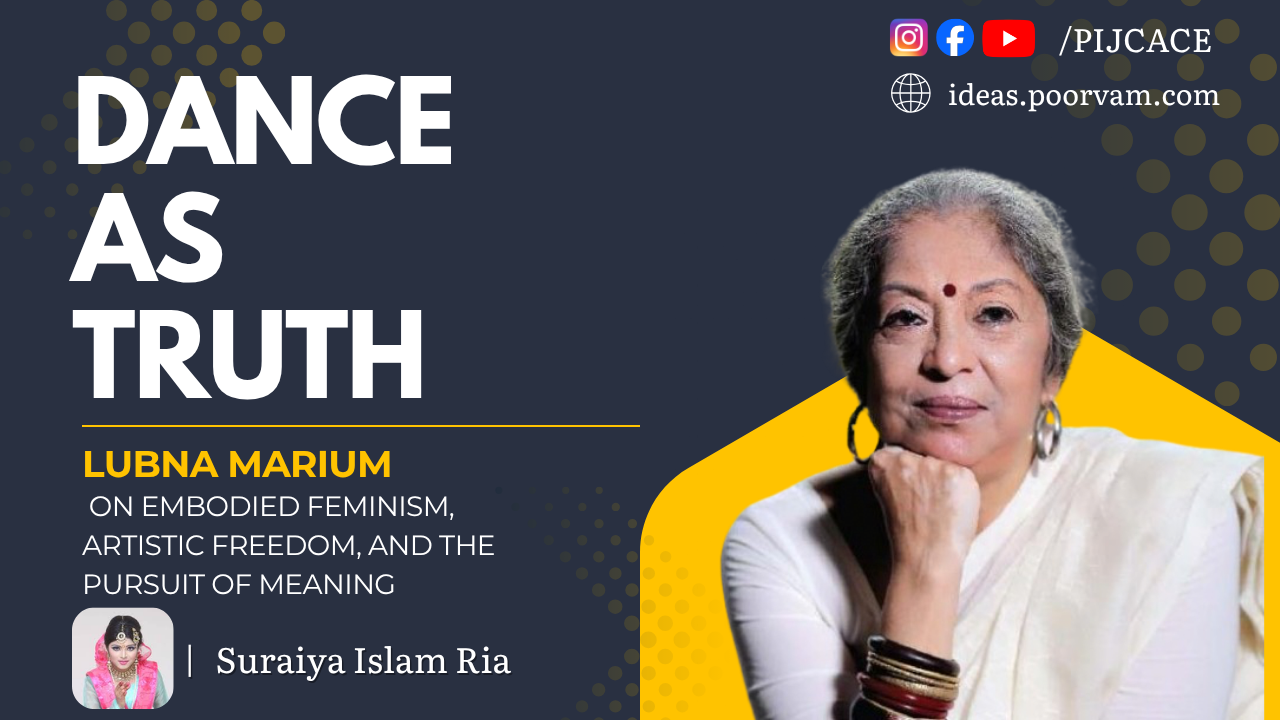
Dance as Truth
Lubna Marium on Embodied Feminism, Artistic Freedom, and the Pursuit of Meaning
In this interview, Lubna Marium — dancer, choreographer, and founder of Dhaka's Shadhona — discusses her new initiative Embodied Feminism, which challenges dancers to use their practice as a vehicle for social commentary and women's empowerment rather than performance alone. She pushes back against the narrative that the arts are in decline in Bangladesh, reflects on the plural religious culture of East Bengal as a foundation for artistic freedom, and traces the intellectual journey — through the Natyashastra, Kashmir Shaivism, and Vajrayana Buddhism — that led her to learn Sanskrit. Her central argument is that art and religion are not in opposition: both, at their core, are in pursuit of truth.

Your new project “Embodied Feminism” — can you tell us about it? What need prompted you to take up this initiative?
The project is targeted towards dancers. The idea is for dancers to expand their practice and think about the fact that dance is an extremely powerful medium. Not just powerful — people want to watch dance. It is attractive. And if through dance we can put forward a powerful statement, bring about some change in society, empower women — why not? Akram Khan's productions, for instance, are extremely powerful.
Of course we use dance in religious festivals, we can dance to mark the changing seasons — but why not use it as a vehicle for powerful messages? Of course we respect Kathak, Bharatanatyam, the classical forms that have always been practiced — but let us try to see if
Continue reading this article
You've reached the end of the free preview. Create a free account — or log in — to read the full piece.
- Unlimited access to every article
- Highlight, annotate & listen
- Comment & join the conversation
- Curated reading list & bookmarks
Free forever · No credit card required · Privacy Policy